Habit Tracking
Recently I started re-reading “Atomic Habits” by James Clear. It is a fantastic book if you are looking into changing your habits, from creating new habits to making bad habits difficult to repeat.
Beyond the idea that good and bad habits are compounding in our lives, what surprised me most was the self-accountability system described in the habit tracker. It is a system which one uses to track over time which habits were successfully executed and which ones would need more focus.
I find this concept very powerful for two reasons:
- It is hard to track habits in one’s mind when there are so many of them we wish to adopt or change.
- It gives us a visual representation of which habits were successfully executed right away, and with other rules such as “no habit must be skipped two days in a row”, it gives us even more accountability.
Now I went a bit further with this concept of habit tracking. When checking on the Internet for what exists, I saw two types of trackers: DIY ones and pre-made ones like printed trackers available as notepads on Amazon for example.
I didn’t like the printed trackers, their designs wasn’t so beautiful and yes I understand I might be a bit harsh here but I felt that for a document I would edit several times a day, it needed to be somehow beautiful enough. DIY trackers would take too much time and eventually defeat the purpose of having little frictions to track habits.
That is why I designed my own tracker using Affinity. Here is how it looks like after just few minutes of playing with the proportions and design:
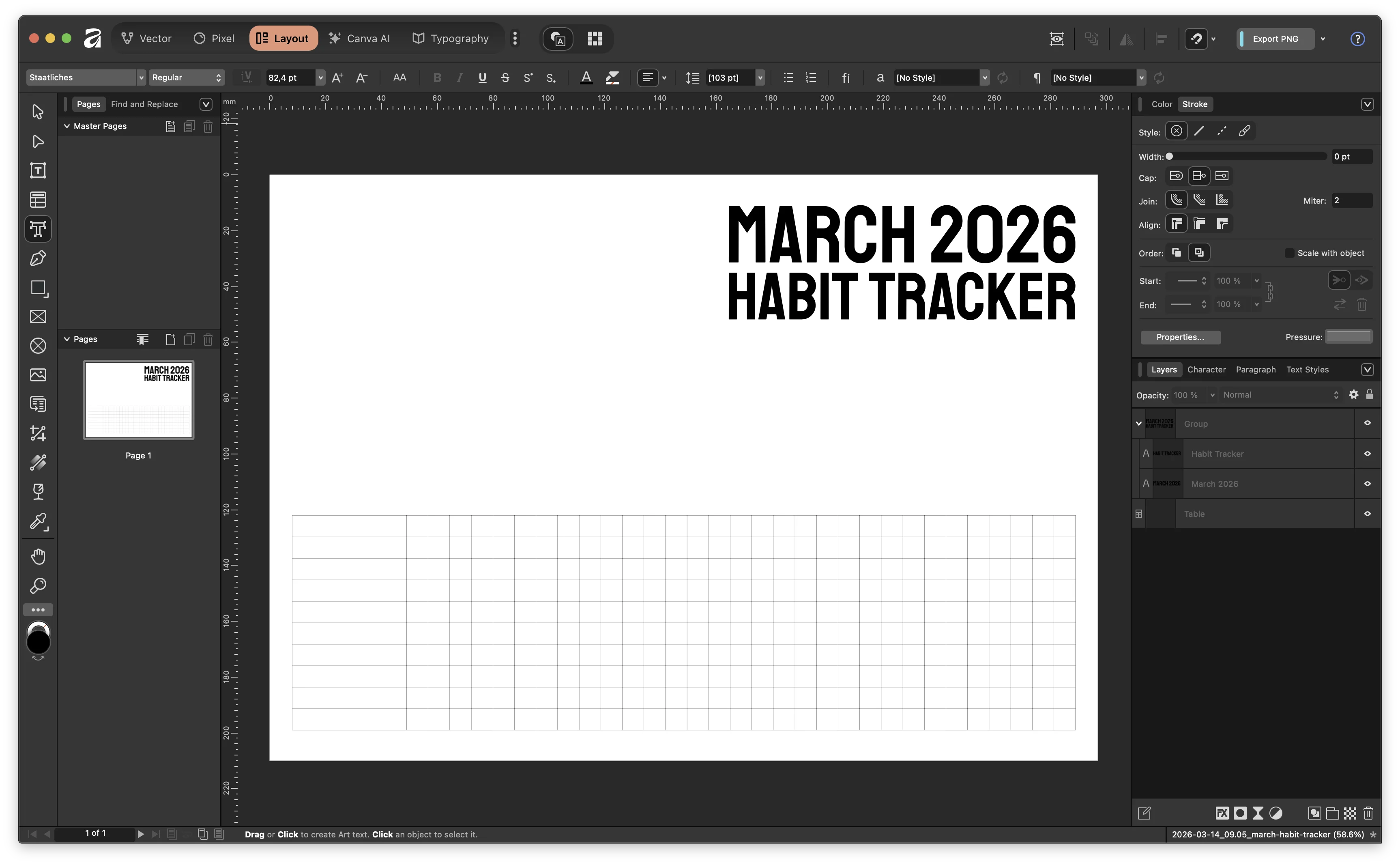
Now you don’t need such document to track your habits, a simple table will be enough for most people. But that gave me happiness and will be subject to many iterations over time.
The whole point of this document is to try, learn and adjust, to make conscious decisions on my own habits, to stop bad ones such as smoking and start again others such as running or journaling.
Here are some of the recent learnings doing that: having many habits to track is hard. It takes mental load to actually remember everything you wish to track. And tracking by itself, even with a sheet of paper, it means you have to be precise in how you wish to implement those habits, when during the day, otherwise you might simply forget one until it’s too late to execute on it.
Also, another learning for me was that it is more important to execute on habits frequently than putting so much focus once on those, meaning it is more important to run everyday slightly than running once heavily every week. The compounding effect on habits makes it that the overall habit will stick better in the long run.
I invite you to create your own habit tracking system and see how beautiful it changes your perspective on how habits are built and how pleasing it is to actually check a box once a habit was successfully executed on a specific day.